Not all of your next visitors will be human
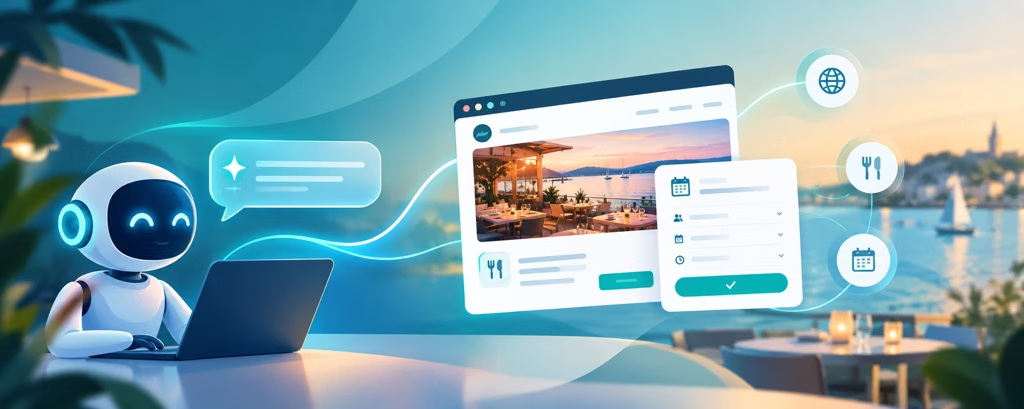
Picture a customer telling their phone: "Find me a table for four on Saturday night at a seafood restaurant near Vannes, and book it." Not long ago, that sounded like science fiction. In 2026, AI assistants such as Gemini, ChatGPT or Copilot can already search, compare and, more and more often, act on the user's behalf.
The problem is that today these assistants use your website like a visitor who can't read the language: they look at the page, guess what each button does, click and hope for the best. It is slow and fragile, and it often ends in an error or a dropped request.
WebMCP was created to fix this. And as with every new web technology, those who look into it early will get a head start.
What is WebMCP? The one-sentence explanation
WebMCP is a user manual that your website hands to AI assistants. Instead of letting the AI guess, your website tells it clearly: "Here is what I can do, here is the information I need, and here is what I'll send back."
Here is a simple comparison. Without WebMCP, an AI assistant is like a customer walking into your shop and looking for the right aisle on their own. With WebMCP, someone at the front desk tells them exactly where to go and what to fill in.
In practice, your website can offer AI assistants actions such as:
- Booking a table, a room or an appointment slot
- Requesting a quote with the right details (type of work, floor area, town…)
- Giving reliable information: opening hours, prices, today's menu, availability
- Filling in a form for contact or registration without mixing up the fields
Where do things stand? A new feature still being tested by Google
To be clear: WebMCP is still in testing (beta). Google presented it at its big annual conference, Google I/O, on May 19, 2026. Since then, any website can sign up for the open testing programme in Google Chrome 149.
It isn't a Google-only gadget: WebMCP is an open standard, discussed within the W3C (the body that sets the common rules of the web), with Microsoft taking part. The goal is for it to eventually work in every browser and with every AI assistant. Google has also announced that Gemini, its assistant built into Chrome, will use it soon.
| When? | Milestone |
|---|---|
| Early 2026 | First prototypes in Chrome, for developers only |
| May 19, 2026 | Official announcement at Google I/O and launch of the testing programme in Chrome 149 |
| September 2026 | CoMi's website becomes WebMCP-ready |
| Coming soon | Used by Gemini in Chrome, then expected in other browsers |
Our take at CoMi. There's no need to panic or rebuild everything tomorrow morning. But things are moving, and it looks a lot like the early days of Google search in the early 2000s: those who got involved early took a place they kept for a long time.
In practice, what does it change for your website?
The simplest way to explain it is with examples. Here is what WebMCP would make possible for different local businesses:
| Your business | What your customer asks their AI assistant | What your website can do with WebMCP |
|---|---|---|
| Restaurant, bar, brasserie | "Book me a table for 4 on Saturday at 8pm, with a gluten-free option" | Check availability, point out suitable dishes and save the booking |
| Holiday cottage, B&B, hotel | "Find a cottage for 6 people from July 12 to 19, pets allowed" | Give exact availability and pricing, then offer a direct booking |
| Tradesperson (plumber, electrician, landscaper…) | "Request a quote to redo a 6 m² bathroom in Auray" | Submit a complete quote request with all the useful details |
| Local shop | "Does the shop have this product in stock? I'll pick it up tonight" | Check stock, give opening hours and prepare an in-store pickup |
| Town hall, local council | "What documents do I need to renew my ID card? Is the village hall free on June 14?" | List the required documents, give opening hours and check the hall's availability |
What about your business?
Which actions could your website hand over to AI?
In 30 minutes, we'll work out with you the 2 or 3 key actions on your website (booking, quote, practical information) that would benefit from being prepared for AI assistants.
The benefits for local businesses
You might think this kind of technology is only for big platforms. It's quite the opposite: WebMCP can help small businesses compete with the giants. Here's why.
1. Get picked by AI assistants
When an assistant has to choose between a website it understands perfectly and one where it has to guess, it will naturally go for the first. A WebMCP-ready website is more likely to be recommended and used. It's a new kind of visibility, on top of traditional Google search.
2. Accurate information, straight from you
Wrong opening hours, old prices, a dish that's no longer on the menu: AI assistants often get things wrong because they pick up information from all over the place. With WebMCP, your website gives the right answer, up to date, straight from the source.
3. Direct bookings, no commission
Today, many bookings go through large platforms that often take 15% commission or more. If your customer's AI assistant can book directly on your website, with no middleman, that margin stays with you.
4. Less time lost on the phone
An incomplete quote request means one more back-and-forth. A call to ask your opening hours is an interruption. When the AI gets the right information and fills in your forms correctly, you receive requests that are ready to handle.
5. A website that's accessible to everyone
Older people, people with visual impairments and anyone uncomfortable with screens are using voice assistants more and more. A website that works well with these assistants is a website that leaves nobody out. This matters especially for local councils and community services.
Local visibility
Get ahead of your competitors
Modern website, local SEO and AI readiness
Most local websites aren't ready for AI assistants. Being among the first in your sector and your town is how you stand out at the right time.
What about security? You stay in control
It's a fair question: is it risky to let an AI act on your website? WebMCP was designed so that people stay in charge:
- You choose what you offer. Only the actions you decide to open up are available to the AI. Nothing else.
- Everything happens in front of the user. The assistant works in your customer's browser, on your real page, not behind the scenes.
- Important actions require confirmation. A payment, a booking or a form submission can require the person's approval before it goes through.
- No new data to share. The AI only accesses information your website already displays or that you have chosen to provide.
At CoMi, we started with our own website
Before offering it to our clients, we wanted to test WebMCP on our own website. It's done: comi-web.fr is already WebMCP-ready.
In practice, an AI assistant visiting our website can now get, directly and without errors:
- the price and content of our showcase website package,
- our subscription plans (hosting and maintenance), monthly or yearly,
- our add-on options and their prices,
- our website ownership and buyout terms,
- the towns and areas we cover.
Hands-on experience
We did it for ourselves, we can do it for you
Setting up WebMCP on your website
We know what works, what's still experimental and what's really worth setting up today. Let's talk, no strings attached.
Should you get started now?
Our advice is simple: don't rush, but don't wait around either. WebMCP doesn't replace the basics, it builds on them. Here is the order we recommend:
- A fast, clear, up-to-date website. This is the foundation: if your website is slow or outdated, neither people nor AI will get what they need.
- Well-organised practical information. Opening hours, prices, address, service area: they should be easy to find and consistent everywhere (website, Google profile, social media).
- One or two key actions prepared for AI. Booking, quote request or practical information: start with what brings you the most business.
- Watch and adjust. The technology is changing fast during this testing phase. Small steps are better than betting everything at once.
Free assessment
Is your website ready for AI assistants?
We review your current website and tell you, in plain language, what's already ready, what's missing and where to start.
In a nutshell
- WebMCP is the user manual your website gives AI assistants so they can book, request a quote or get information without mistakes.
- It's still in testing in Google Chrome since May 2026, but it's an open standard backed by Google and Microsoft.
- Local businesses have a lot to gain: more visibility, accurate information, direct bookings and less time wasted.
- You stay in control of what the AI can do, and important actions are still approved by your customer.
At CoMi, our job is to make these new technologies simple and useful for the shopkeepers, tradespeople, accommodation providers and councils in our area. WebMCP is part of that: we've tested it on our own website, and we're ready to support you when the time is right for you.
The CoMi team
Editorial team - CoMi