Introduction
Natural search optimization, also called SEO (Search Engine Optimization), represents an essential growth lever for small and medium-sized businesses looking to develop their online visibility. In a digital environment where competition is intensifying, understanding and mastering SEO fundamentals becomes a strategic necessity for any SME wanting to attract new customers through search engines.
What is SEO?
SEO refers to all the techniques aimed at improving a website's position in search engine results like Google, Bing or Yahoo. The main objective is to appear in the first search results when an internet user performs a query related to your business.
Unlike paid search (SEA), SEO relies on organic methods that allow you to get qualified traffic without paying directly for each click. This approach is particularly relevant for SMEs with limited marketing budgets but wanting to build a sustainable digital presence.
The Three Pillars of Natural Search
SEO is built around three fundamental components that work together to improve your visibility:
Technical SEO concerns your website's infrastructure. It includes page loading speed, mobile device optimization, URL structure, robots.txt file, XML sitemap, as well as site security via HTTPS protocol. These technical elements allow search engines to navigate your site efficiently and properly index your pages.
On-Page SEO focuses on optimizing your pages' visible content. This dimension includes your text's editorial quality, strategic keyword use, heading and subheading structure, meta tags, image alt attributes, as well as internal linking between your different pages. Each page must be designed to answer a specific search intent.
Off-Page SEO groups actions performed outside your site to strengthen your authority. Backlinks, i.e. links from other websites pointing to yours, constitute the central element of this strategy. The quality and relevance of these links directly influence how search engines perceive your expertise.
Why is SEO Crucial for an SME?
For a small or medium-sized business, investing in natural search represents much more than a simple marketing approach. This strategy offers concrete and measurable advantages that directly impact business growth.
A Profitable Long-Term Investment
Natural search stands out for its excellent return on investment. Unlike advertising campaigns that stop generating traffic as soon as spending stops, SEO efforts produce lasting results. Once a page reaches good positioning, it continues to attract visitors for months or even years, without additional cost per click.
| Channel Type | Initial Cost | Recurring Cost | Durability | Long-Term ROI |
|---|---|---|---|---|
| SEO | Medium to High | Low | High | Excellent |
| SEA (Google Ads) | Variable | High | None | Limited |
| Organic Social Media | Low | Medium | Medium | Good |
| Display Advertising | Low to Medium | High | None | Low |
Optimize your ROI
Develop your online visibility now
Custom SEO strategy for SMEs
Our team of experts supports you in implementing a high-performance and sustainable SEO strategy, adapted to your budget and objectives.
Target Customers at the Right Time
Search optimization allows you to intercept prospects at the precise moment they are actively searching for your products or services. This qualified search intent translates into conversion rates generally higher than other acquisition channels. A user typing emergency plumber Lyon into Google shows an immediate and concrete need, unlike a person who sees an advertisement passively.
Strengthen Your Business Credibility
Appearing in the first search results confers important legitimacy and credibility. Internet users instinctively associate the first positions with reliable and recognized companies in their field. This positive perception favorably influences their purchasing decision and strengthens your brand awareness.
Essential Steps to Optimize Your Site's SEO
Implementing an effective SEO strategy for an SME requires following a structured methodology. Here are the essential steps to build solid foundations.
Perform Relevant Keyword Analysis
Keyword research constitutes the starting point of any successful SEO strategy. This analysis allows you to identify the terms and expressions your target audience actually uses to search for your products or services.
Start by drawing up a list of keywords related to your business, then use specialized tools to assess their search volume and competition level. For an SME, it often proves wiser to target long-tail keywords, i.e. more specific and less competitive expressions, rather than generic terms monopolized by large companies.
For example, an accounting firm in Marseille will have more chances of positioning itself on chartered accountant SME Marseille 13008 than on the generic term chartered accountant, while attracting a more qualified and local audience.
Optimize Your Site's Technical Structure
Your website's technical performance directly influences your search ranking. Search engines favor sites offering an optimal user experience.
Make sure your site loads quickly, ideally in less than three seconds. Loading speed impacts both search ranking and visitor bounce rate. Compress your images, minify your CSS and JavaScript code, and consider using a content distribution network (CDN) to improve performance.
Mobile adaptation now constitutes an essential criterion. With more than 60% of searches performed from smartphones, Google uses mobile-first indexing, which means your site's mobile version serves as the ranking reference. Regularly test your site on different devices and screen sizes.
Structure your URLs clearly and descriptively. A URL like yoursite.com/services/plumbing-renovation is much more effective than a URL like yoursite.com/page?id=123. Readable URLs facilitate content understanding by search engines and users.
Create Quality and Optimized Content
Content represents the heart of your SEO strategy. Search engines seek to offer the most relevant answers to users' queries, which values sites offering rich, informative and well-structured content.
Write texts that truly answer your audience's questions. Favor depth and added value rather than simple keyword accumulation. A 1500-word article providing precise and actionable information will always surpass a 500-word text stuffed with keywords without real substance.
Use a consistent heading hierarchy with a single H1 title per page, followed by H2 titles for main sections, then H3 for sub-sections. This structure facilitates reading and helps search engines understand your content's organization.
Naturally integrate your main keywords in strategic elements: the H1 title, first paragraphs, H2 and H3 subheadings, as well as in the body text. However, avoid over-optimization which could be penalized by algorithms.
Optimize Meta Tags
Meta tags, although invisible on the page, play a determining role in your search ranking and click-through rate.
The title tag appears as a clickable title in search results. It must contain your main keyword, stay under 60 characters to avoid truncation, and make people want to click. A good title combines relevant information and call to action.
The meta description, limited to 155-160 characters, offers a summary of your page under the title in search results. Although it doesn't directly influence ranking, a convincing description significantly improves your click-through rate, which sends positive signals to search engines.
Develop Your Internal Linking
Internal linking refers to links between different pages of your own site. This practice improves navigation for users and helps search engines discover and understand your site's structure.
Create contextual links between your pages using descriptive anchor text. Rather than using click here, prefer formulations like discover our preventive maintenance services which bring context and SEO value.
Establish a silo architecture that groups content by theme. This organization facilitates understanding of your expertise by search engines and improves user experience.
Obtain Quality Backlinks
External links pointing to your site constitute one of the most important ranking factors. Each backlink represents a vote of confidence from another site towards yours.
Favor quality over quantity. A link from an authority site in your sector is worth much more than dozens of links from irrelevant or low-quality sites. Local professional directories, partnerships with complementary organizations, or mentions in local press constitute excellent opportunities for SMEs.
Create remarkable content that naturally encourages sharing and citations. Case studies, complete guides, infographics or original data spontaneously generate backlinks when they bring real added value.
Boost your authority
Build an effective link building strategy
Our experts help you develop a solid and natural backlink profile to strengthen your site's authority and improve your positions on Google.
Local SEO Optimization: A Powerful Lever for SMEs
For businesses serving local or regional clientele, local search optimization represents an exceptional visibility opportunity.
Create and Optimize Your Google Business Profile
Google Business Profile (formerly Google My Business) constitutes the essential tool for local SEO. A complete and optimized listing considerably improves your visibility in geolocated searches and in Google Maps.
Meticulously fill in all information: exact company name, complete address, phone number, opening hours, activity categories, and detailed description of your services. Add quality photos of your establishment, your team and your achievements.
Encourage your satisfied customers to leave reviews and take time to respond to all comments, whether positive or negative. Reviews directly influence your local ranking and prospects' trust.
Use Local Keywords
Systematically integrate geographic references into your content, meta tags and titles. Mention your city, department, region, as well as the neighborhoods or areas you serve.
Create dedicated pages for each geographic area if you operate in multiple locations. These pages must offer unique and relevant content for each area, avoiding content duplication which would be penalized.
Dominate your local market
Maximize your local visibility on Google
Personalized local SEO
We optimize your local presence to attract more customers in your catchment area through a complete and effective local SEO strategy.
Common SEO Mistakes to Avoid
Even with the best intentions, certain practices can harm your search ranking. Identifying and correcting these errors helps avoid penalties and optimize your results.
Duplicate Content
Content duplication, whether internal (several identical pages on your site) or external (copying content from other sites), represents one of the most penalizing errors. Search engines favor originality and can downgrade or even exclude from the index pages presenting duplicate content.
Systematically create original and unique content for each page. If you must reuse similar information, substantially reformulate it and add specific value to each context.
Keyword Over-Optimization
Excessive and artificial keyword insertion, called keyword stuffing, harms readability and is detected by modern algorithms. Search engines have considerably evolved and now understand the overall semantic context of a text.
Write naturally for your readers first, integrating your keywords in a fluid and contextual way. Use synonyms and related terms to enrich your semantic field.
Neglecting Mobile Experience
With Google's mobile-first indexing, a site not adapted to mobiles suffers significant penalties. Mobile users represent the majority of web traffic, and offering them a degraded experience negatively impacts your search ranking and conversions.
Adopt a responsive design that automatically adapts to all screen sizes, regularly test your site on different devices, and verify that all interactive elements (buttons, forms) are easily usable on mobile.
Ignoring Structured Data
Structured data, also called schema markup, helps search engines better understand your pages' content and can generate rich snippets in search results. These enriched excerpts (review stars, prices, availability, etc.) significantly increase your click-through rate.
Implement relevant schemas for your business: LocalBusiness for your local business, Product for your products, FAQ for your frequently asked questions, or Review for your customer reviews.
Avoid costly mistakes
Have your site audited by our SEO experts
Identify and correct errors that slow down your search ranking. Our complete SEO audit analyzes all technical, on-page and off-page aspects of your site.
Measure and Analyze Your SEO Performance
An effective SEO strategy relies on continuous analysis of results and adjustment of actions based on observed performance.
Key Indicators to Track
Several metrics allow you to assess your SEO efforts' effectiveness and identify areas for improvement.
- Organic traffic measures the number of visitors arriving on your site via search engines. Regular growth of this traffic indicates that your efforts are bearing fruit.
- Keyword ranking allows you to track your pages' evolution in search results for your target keywords.
- Organic conversion rate reveals your strategy's real effectiveness. Attracting traffic is not enough if it doesn't convert into leads.
- Domain authority and backlink profile give an indication of how search engines perceive your site.
Essential Tools
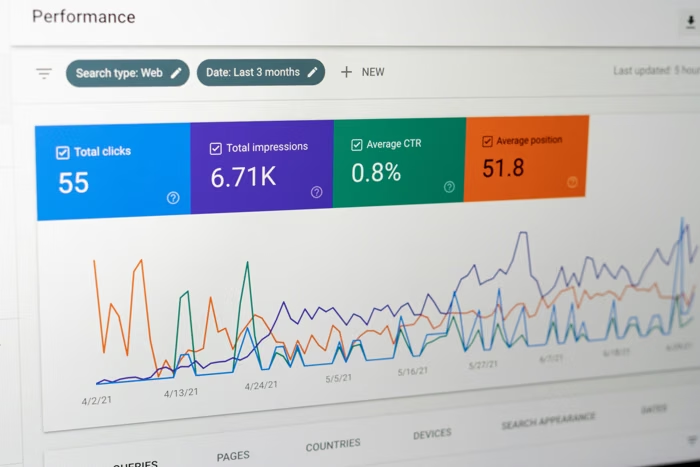
Google Search Console constitutes the essential free tool for any website owner. It provides valuable data on your performance in search results, indexing errors, technical issues, and improvement opportunities.
Google Analytics allows you to understand your visitors' behavior, identify the most performing pages, and measure business objectives achievement. Traffic segmentation by source allows you to isolate organic channel performance.
Specialized tools like SEMrush, Ahrefs or Moz offer advanced features for keyword analysis, rank tracking, technical audit, and competitive analysis. Although paid, these tools prove valuable for SMEs wanting to deepen their SEO strategy.
How Long Does It Take to See Results?
Natural search represents a medium and long-term strategy that requires patience and perseverance. Unlike advertising campaigns that generate immediate results, SEO progressively builds your visibility.
In a less competitive sector, the first tangible results can appear after three to six months of sustained efforts. For more competitive markets, it generally takes six to twelve months before observing significant improvements in ranking and traffic.
This timing is explained by how search engines work. Google must first discover your new pages or modifications, index them, then evaluate their relevance and authority before positioning them favorably. This process takes time, especially as algorithms observe user engagement with your content over time.
The key to success lies in regularity and consistency. Weekly publication of quality content, combined with continuous technical optimizations and progressive backlink acquisition, produces cumulative results that amplify over time.
SEO Budget: What Investment for an SME?
The budget needed for an effective SEO strategy varies considerably according to your objectives' ambition, your sector's competition level, and available internal resources.
An SME can consider three main approaches depending on its means and skills.
- The DIY (Do It Yourself) approach suits entrepreneurs with time and desiring to acquire SEO skills. Costs are limited to tools (100 to 300 euros monthly) and online training.
- Using a freelance SEO represents a good compromise for moderate budgets. Rates generally vary between 500 and 2000 euros monthly depending on the professional's experience.
- Collaboration with an SEO agency addresses SMEs with a larger budget. Agency services generally start around 1500 to 3000 euros monthly.
Conclusion: SEO, a Strategic Investment for Your SME
Natural search represents much more than a simple marketing technique for small and medium-sized businesses. It constitutes a strategic lever for sustainable growth which, correctly implemented, generates a constant flow of qualified prospects without dependence on advertising budgets.
A successful SEO strategy is based on three fundamental pillars: a solid technical base, quality content meeting your audience's needs, and authority progressively built through quality links. These elements, combined with a relevant local approach for proximity businesses, create conditions for optimal visibility in search engines.
SMEs that invest in natural search today are building a digital asset that will generate value for years. Each optimized page, each published content, each obtained link progressively strengthens your online presence and your ability to capture new customers.
Start with fundamentals, regularly measure your progress, and adjust your strategy based on observed results. SEO is not a destination but a continuous journey of improvement and adaptation to evolutions in search behaviors and algorithms. With patience, consistency and a methodical approach, your SME can effectively compete with larger competitors and conquer its place in the first search results.

The CoMi Team
Web agency — CoMi