Why a showcase website has become essential for tradespeople
In 2026, a tradesperson without a website is a tradesperson your future clients will never find. Yet, having a website is not enough: it must be designed to convert a visitor into a quote request. This guide shows you concretely what works — and what no longer works — for a trades website this year.
Your clients' Google reflex
Before hiring a tradesperson, a homeowner almost always starts with an online search. Whether looking for a plumber, carpenter or electrician, the first reflex is to go to Google. If you're not there, your competitor gets that client.
The France Num 2025 Barometer, published by the General Directorate of Enterprises, confirms this trend: 84% of micro and small businesses now have at least one online visibility solution, and 78% of business owners consider that digital technology is a real benefit for their activity. Among the main advantages cited: acquiring new customers (48%) and facilitating communication with existing customers (77%).
Word of mouth has changed its form
In the past, a tradesperson lived on local word of mouth. This is still true in 2026, except that this word of mouth now flows through Google reviews, social media recommendations and shared links. When a neighbour recommends your work, the first thing the person does is search your name on Google. If they find nothing, or land on an outdated site, trust erodes immediately.
A clean, up-to-date showcase website acts as a permanent business card. It reassures, it proves your professionalism, and it allows people to contact you in two clicks, even on a Sunday evening.
What a showcase website is not
It is not about selling online. A tradesperson does not need an e-commerce site. The showcase website has a simple and precise objective: present your activity, show your work and generate quote requests or calls. It is a commercial tool, not an online shop.
The 5 essential pages of a tradesperson's showcase website
A good trades showcase website does not need fifteen pages. Five are needed, well thought out, well written and well structured.
1. The homepage: your showcase in 5 seconds
When arriving on your homepage, a visitor must understand in less than five seconds three things: what you do, where you work, and how to contact you. This is the principle of immediate clarity.
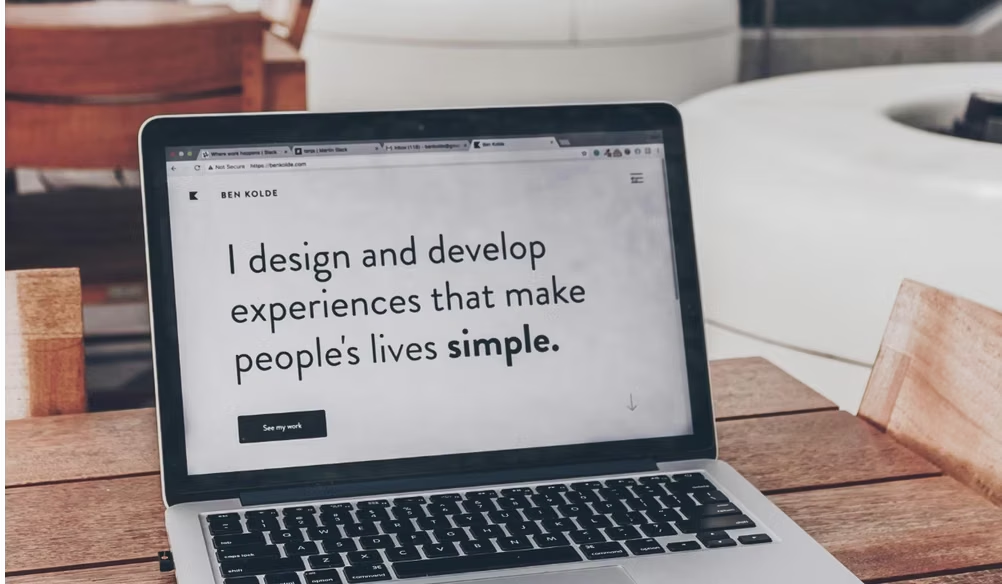
Concretely, your homepage must contain an explicit title incorporating your trade and your geographic area (for example: "Carpenter in Vannes — bespoke manufacturing and renovation"), one or two sentences summarising your added value, a visible call-to-action button ("Request a free quote"), and a professional photo of your work or workshop. Avoid image carousels, unnecessary animations and overly long texts. Simplicity converts better than spectacle.
2. The services page: detail what you do
This is the most strategic page for your SEO. It must clearly list your services using language your clients use (not technical jargon). Think about what someone types on Google when they're looking for a tradesperson like you.
An electrician in Lorient could structure their page with sections like: electrical panel installation, electrical compliance upgrades, emergency electrical repairs, EV charging point installation. Each service deserves a dedicated paragraph of a few lines.
3. The portfolio page: proof through images
For a tradesperson, this page is the equivalent of a portfolio. Before/after photos are particularly effective. A tiler who shows a bathroom before and after their work creates an immediate and measurable visual impact.
A few rules for this page: use quality photos (natural light is often sufficient, a recent smartphone works very well), add a short description under each project (type of work, location, duration), and remember to optimise images by giving them a descriptive name and a relevant ALT tag, such as "bathroom-renovation-vannes" rather than "IMG_4523".
4. The about page: show the face behind the trade
People hire a tradesperson, not an anonymous company. This page humanises your activity. Talk about your background, your values, what sets you apart. If you have certifications or labels, this is where they should be displayed.
A photo of you at work is worth more than a long speech. It creates proximity and trust.
5. The contact page: keep it simple
This is the conversion page. It must be accessible in one click from any page on the site. It contains a simple form (name, email, phone, message — not fifteen fields), your clickable phone number, your address or service area, and a Google Maps embed if you have a workshop or premises.
A well-designed form can significantly increase your quote requests. Every extra field means one fewer client.
Free quote
Need a professional website for your business?
Our experts design showcase websites optimised for tradespeople: visible on Google, fast and designed to convert your visitors into clients.
Local SEO: the key to appearing in your city
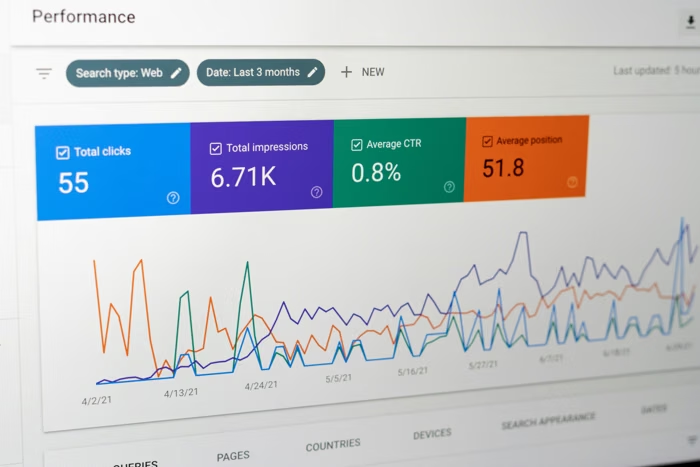
Local SEO is the most powerful lever for a tradesperson. When someone types "plumber Nantes" or "builder Brittany", Google prioritises geolocated results: the map with business listings, then the sites best optimised for that local search.
Understanding local SEO
Your goal is to appear in these results. And unlike national SEO, local competition is often much more accessible.
Local SEO rests on three pillars: a website optimised with geolocated keywords, a complete and up-to-date Google Business Profile, and regular positive client reviews.
Google Business Profile: your second showcase
If you do only one thing after reading this article, do this: create and optimise your Google Business Profile (formerly Google My Business). This is the small card that appears to the right of Google results or directly in Google Maps.
To optimise it, accurately specify your main business category, write a complete description incorporating your services and service area, add photos regularly (at least one per month), and above all, ask your satisfied clients for reviews. Google reviews have become the primary trust criterion for people looking for a tradesperson.
Local keywords: speak like your clients
Naturally incorporate in your texts the terms your potential clients type on Google. This means systematically associating your trade with your geographic area. For example: "painter decorator Quimper", "facade rendering Brest", "electrical panel installation Saint-Malo", "garage construction Brittany".
The idea is to build a list of around ten main keywords that perfectly describe your services and your area of operation. These terms will then guide all the writing on your site.
Mobile, speed, design: the three technical pillars
Beyond content, the technical performance of your site plays a decisive role in your visibility and conversion rate.
A readable site on smartphones is mandatory
More than half of local searches are done on mobile. A tradesperson looking for clients in their city must absolutely have a site that displays correctly on smartphones: readable text without zooming, buttons large enough to tap with a finger, clickable phone number directly.
In 2026, Google indexes the mobile version of your site first. If your site is not responsive (adapted to all screens), it will be penalised in search results, even on desktop.
Loading speed: a conversion factor
A site that takes more than three seconds to load loses a large proportion of its visitors. For a tradesperson, this means fewer quotes. The factors that slow down a site the most are images that are too large and uncompressed, WordPress themes overloaded with unnecessary features, and unoptimised plugins.
A well-designed showcase site, with compressed images and a lightweight architecture, loads in less than one second. This is a concrete competitive advantage over competitors who use heavy, poorly configured solutions.
A professional but clean design
The design of a tradesperson's showcase site does not need to be spectacular. It must be clean, readable and inspire trust. The elements that matter are a readable typeface and appropriate text sizes, colours consistent with your visual identity (two or three colours maximum), sufficient spacing between content blocks, and no superfluous animations.
A site that looks like a professional site inspires confidence. A site that looks like amateur DIY drives people away.
What has changed in 2026
The web landscape evolves rapidly. Here are the trends directly impacting tradespeople this year.
AI at the service of tradespeople
The France Num 2025 Barometer reveals that AI adoption by micro and small businesses has doubled in one year: 26% of businesses now use it, compared to 13% in 2024. For a tradesperson, AI can simplify time-consuming tasks such as writing website content, responding to quote requests, or creating social media content.
Be careful however: AI is a tool, not a miracle solution. A text generated by AI without human review is immediately identifiable and can harm your credibility. AI should help you save time, not replace your expertise.
Client reviews matter more than ever
In 2026, trust remains the decisive factor in choosing a tradesperson. And this trust is built primarily online, through client reviews. A tradesperson with 40 reviews at 4.8/5 on Google will always have the advantage over a competitor without reviews, even if the latter has a better-looking site.
The best practice is to systematically ask for a review from each satisfied client, by sending them the direct link to your Google profile after the work is completed.
A living site, not a static one
Google values sites that are regularly updated. For a tradesperson, this does not mean writing a blog every week. It means adding your new completed projects as you go, updating your services if your offering evolves, and responding to Google reviews (positive and negative alike).
A site unchanged for two years gives the impression of an inactive business, even if that is not the case.
Our work
Discover the websites created by CoMi
Concrete examples of sites for tradespeople and retailers
Each project is designed to measure to reflect our clients' identity and generate quote requests.
Mistakes that cost you dearly
Certain mistakes recur regularly among tradespeople who go online. Knowing them allows you to avoid them.
Building your own site 'to save money'
The temptation is strong, but the result is rarely up to standard. A site built with a free tool, without mastery of design and SEO, will be invisible on Google and project an amateur image. The time spent tinkering with a mediocre site is time you are not spending on your trade.
According to the France Num Barometer, 37% of micro and small business owners want to train in digital skills but don't know who to turn to. This is exactly where professional support makes the difference.
Neglecting HTTPS and legal notices
A site without an SSL certificate (the small padlock icon in the address bar) is flagged as "Not secure" by browsers. This is a dealbreaker for trust.
Similarly, legal notices, the privacy policy and GDPR compliance are legal obligations that many tradespeople forget.
Underestimating maintenance costs
A website is not a one-time investment. It requires hosting, security updates, and regular adjustments. Budget for this from the start to avoid unpleasant surprises.
| Cost item | Traditional web agency | CoMi |
|---|---|---|
| Website creation (up to 5 pages) | €3,000 to €8,000 | From €550 |
| Annual hosting + maintenance | €500 to €900/year | From €450/year |
| Licences and plugins | €50 to €500/year | €0 |
Checklist: the 10 points to check on your showcase website
Before putting your site online or during an audit of an existing one, check that these 10 essential points are validated.
Your complete checklist
- My trade and my city appear in the homepage title.
- My site displays correctly on smartphones (test it yourself).
- My phone number is clickable on mobile.
- My services are detailed using the words my clients use.
- My completed projects are illustrated with quality photos.
- My contact form has a maximum of 4 fields.
- My Google Business Profile is created, complete and up to date.
- I have at least 10 Google reviews with a rating above 4.5/5.
- My site loads in less than 3 seconds.
- Legal notices and the privacy policy are present.
FAQ
Answers to the most frequently asked questions from tradespeople about creating their showcase website.
How much does a showcase website cost for a tradesperson in 2026?
Prices vary enormously depending on the approach. At a traditional web agency, expect between €3,000 and €8,000 for creation, then €500 to €900 for annual maintenance.
At CoMi, creating a professional showcase website starts at €550, with a maintenance and hosting subscription from €45/month. The site is custom-built, responsive and SEO-optimised.
Does a tradesperson really need a website if they already have a Facebook page?
Yes. A Facebook page does not belong to you, it belongs to Meta. The algorithm decides who sees your posts, and you have no control over your visibility.
A website, on the other hand, is your space. It appears in Google results, it positions you as a serious professional, and it works 24/7 without depending on a third-party platform.
How long does it take to create a tradesperson's showcase website?
A 5-page showcase website can be operational within 2 to 4 weeks at CoMi, including time for exchanging content and design feedback. The faster you provide your texts and photos, the shorter the timeline.
Is a showcase website enough to find clients?
The website is the foundation, but it is not enough on its own. It must be complemented by an optimised Google Business Profile, regular client reviews, and ideally a presence on social networks suited to your activity. Together they form a coherent digital ecosystem that generates qualified leads.
WordPress, Wix, or something else: which platform to choose?
Each solution has its advantages, but for a tradesperson who wants a professional result without worrying about the technical side, the best option is to entrust the creation to a specialist. CoMi builds custom sites with a lightweight, high-performance architecture, no plugins or licences to pay for, and handles technical maintenance so you can focus on your trade.

The CoMi Team
Web agency — CoMi